VIDEO | A Romanian journalist, correspondent in Ukraine, has been banned from entering the Transnistrian region

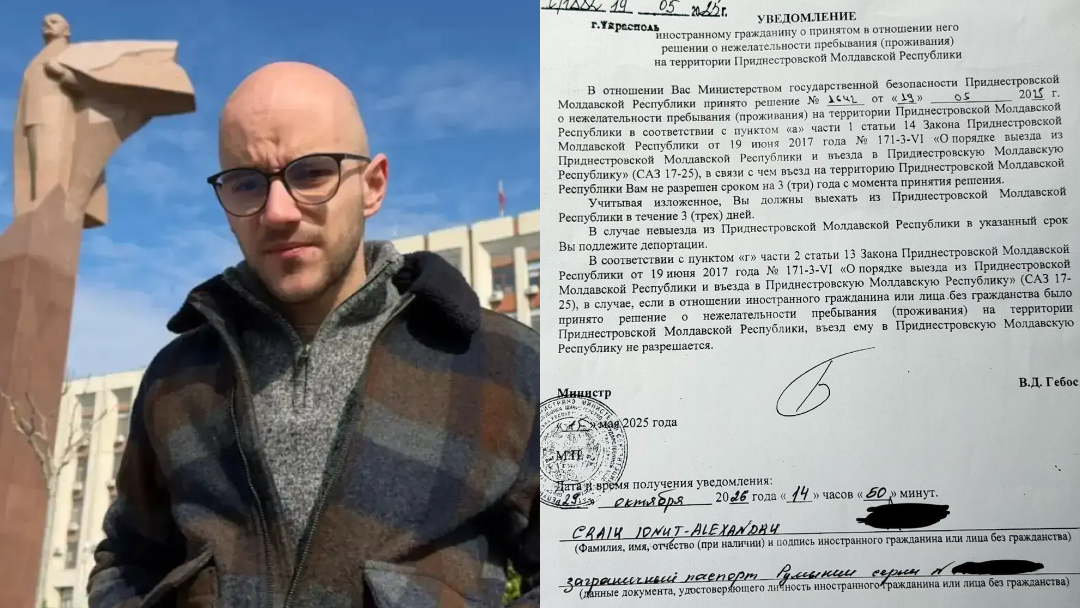
Romanian journalist Alex Craiu, Veridica's correspondent in Ukraine, has been banned from entering the Transnistrian region for three years. The measure was communicated to him on October 29 at the Dubasari checkpoint, located in the separatist region controlled by the Tiraspol authorities, writes Veridica.

"Regarding you, the Ministry of State Security of the Transnistrian Moldavian Republic adopted decision No. 1642 of May 19, 2025 on the undesirability of stay (residence) on the territory of the Transnistrian Moldavian Republic," the document presented to Alex Craiu states. The decision indicates that "you are not allowed to enter the territory of the Transnistrian Moldavian Republic for a period of 3 (three) years from the date of adoption of the decision. Given the above, you must leave the Transnistrian Moldavian Republic within 3 (three) days. In case of failure to leave the Transnistrian Moldavian Republic within the specified period, you will be subject to deportation," the document presented to Alex Craiu states.
In response, the Reintegration Policy Bureau condemned this "new abuse" and noted that "we will continue to insist on the restoration of journalists' access to the Transnistrian region in the existing dialogue formats between Chisinau and Tiraspol."
"This case once again demonstrates that the propaganda regime in Tiraspol and the so-called local power structures maintain a fierce information censorship, restricting and declaring undesirable the activity of journalists who objectively reflect the sad realities on the ground and the alarming human rights situation in the region. We firmly condemn this new abuse and will continue to insist on the restoration of journalists' access to the Transnistrian region in the existing dialogue formats between Chisinau and Tiraspol, while free movement on the territory of the country and freedom of the media are guaranteed constitutionally and internationally," the Bureau wrote.
The decision to ban the journalist and content creator comes into effect on May 19, 2025, exactly three weeks after the publication of a video in which Alex Craiu showed the reality of Tiraspol, the self-proclaimed capital of a country that does not exist, legally.
This is not the first time Alex Craiu has had problems with the Transnistrian authorities. In 2022, he was detained by the security service in Cuciurgan and later interrogated for three hours in Tiraspol, during which time his personal phone was taken away, and he was asked for its access code beforehand, for investigations under suspicion of espionage.
Following the interrogation at that time, no sanction or ban was imposed on the journalist, as the authorities did not find, following thorough searches, any evidence indicating any illicit action by Craiu in Transnistria.
On Thursday, October 29, 2026, when the journalist's entry into Transnistria was refused, the authorities at the so-called Transnistrian border did not present a precise reason for his ban, only informing him that he had to sign the notification of the decision written only in Russian, without a translation into Romanian or English.
The Tiraspol authorities could not be contacted for comment, as the phone numbers on the official website of the Ministry of State Security in Tiraspol are not reachable from outside Transnistria or are incorrect.
